Sustainability in the OR – eNewsletter
ISSUE 13 – 2026
New Anesthesia Machines Swoop In!
While prior SITOR e-newsletters educated readers on how to safely and effectively reduce fresh gas flows in order to reduce greenhouse gas release to our environment, the anesthesia machine manufacturers have leaped in to further facilitate this task. Technological advancements and software development have been successful in assisting providers with attaining maximal sustainable volatile agent delivery. This is real progress and a huge win for sustainability in the OR.
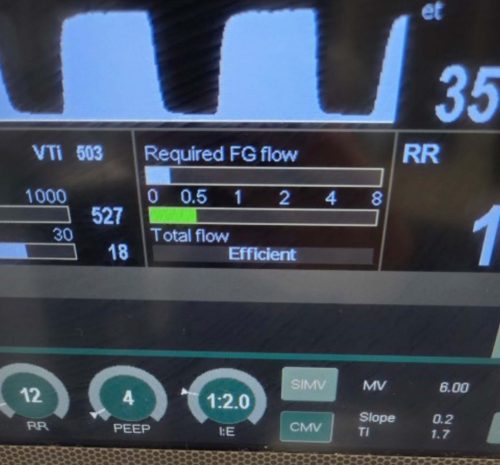
- Drager anesthesia machines have the “Low Flow Wizard” technology combined with piston driven “bellows”. The Low-Flow Wizard display shows you the “Required FG Flow” and “Total Flow” (what your flows are). Any flow rates greater than requirement are indicated as “Efficient” which is Drager’s word for “Sufficient”. Since the system continuously displays required fresh gas (FG) flow, the provider can see in real time whether their delivered fresh gas flows are at or above what is required for ventilation. As shown in the example (photo), fresh gas flows as low as 0.3 – 0.4 L/M will typically be sufficient for “efficient” ventilation. As usual, keep an eye on the FiO2 and adjust if needed.
How is this physically possible?
- These machines are built “tight” to have minimal to no leak.
- The gas analyzer flow is returned to the circuit.
- The software considers all losses and additions of flow: These algorithms assess fresh gas entering the breathing system, oxygen and volatile agent uptake by the patient, CO2 production by the patient, leakage into the environment, CO2 absorption by the absorbent, and waste gas into the WAGD. By adding up all of the “losses” it is possible to calculate a required amount of FG flow.
- GE anesthesia machines have the End-tidal Control software system that allows providers to set targets for end-tidal volatile agents. The system automatically adjusts the fresh gas flows breath-by-breath such that once the target is attained, flows decrease substantially (below 1 L/M) during anesthesia maintenance.
Final Thought
Connect & Learn More
Adam Fischler, M.D.
Integrated Anesthesia Associates
Associate Clinical Professor, Department of Anesthesiology, UCONN Health
Chair, OR Sustainability Committee, UCONN Health
iaapartners.com/sustainability
adam.fischler@iaapartners.com
860-679-4824
APSF Low-Flow Anesthesia Course
Become a low-flow anesthesia expert and earn CME’s!
Complete this hands-on low-flow anesthesia course (if you haven’t done so already). Earn CMEs through APSF.org. This APSF module will greatly assist you in becoming much more comfortable with the concepts of safe delivery of low-flow anesthesia.
Spread the word
As has been said by many individuals in various ways:
“We did not inherit this earth; we are borrowing it from our children.”
Please use the contact information above to get in touch. I’d love to hear from you.
